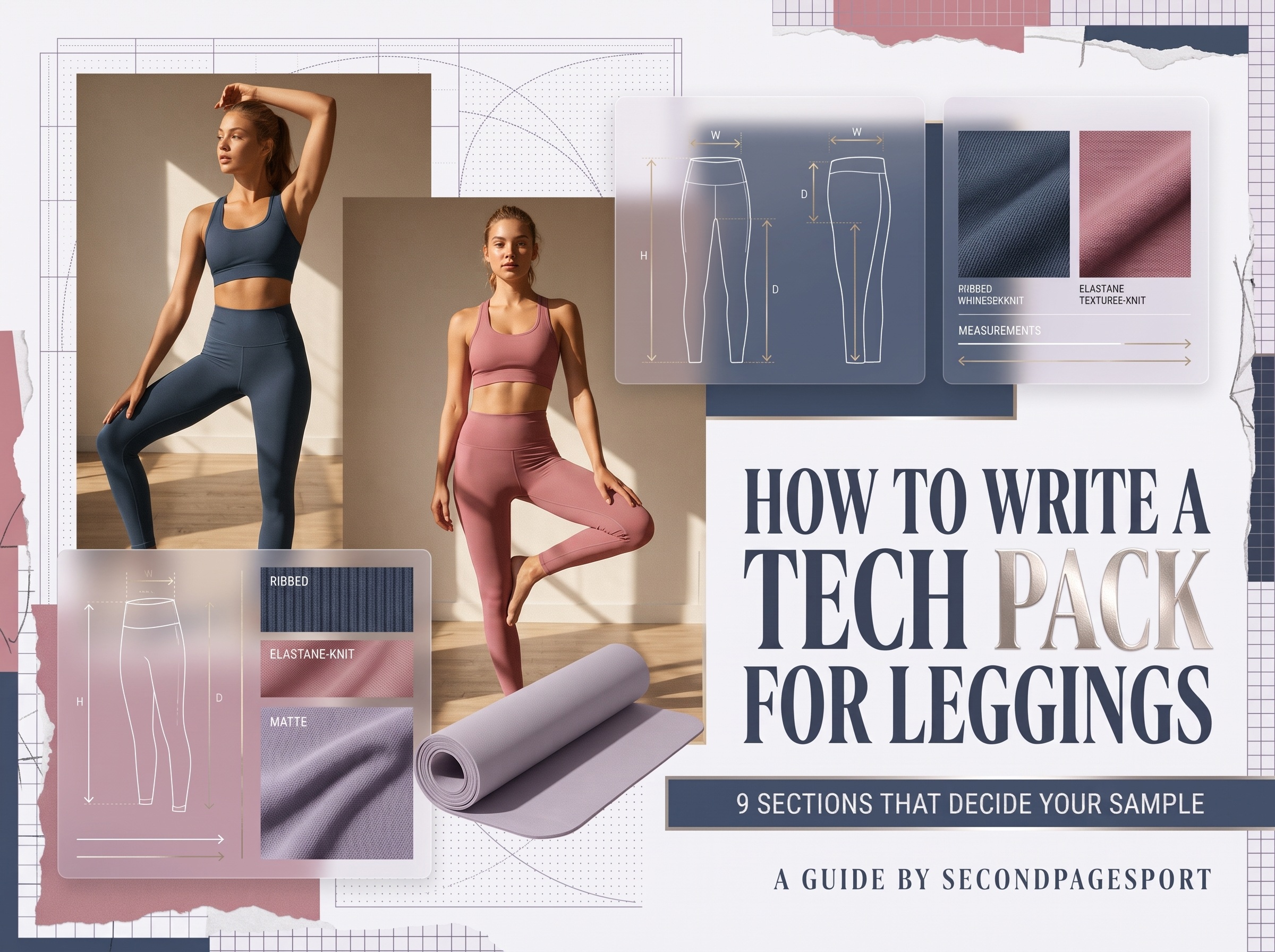
How to Write a Tech Pack for Leggings: 9 Sections That Decide Your Sample
A leggings tech pack is a production document that tells a factory how to build one style without further design input — fabric, measurements, construction, colour, labels and packing. Writing one means filling nine sections and attaching a reference sample. A complete pack usually clears in one or two sample rounds; a sketch and a photo usually cost three. At HEFEI SECOND PAGE TECH, custom samples take 3–5 days; in-stock styles sample in 1–3 days.
What a tech pack is
A tech pack (technical package, also called a spec sheet) is the document set a factory uses to cost, pattern, cut and sew a garment. Two pattern makers in two factories should read it and build the same legging.
Leggings make that brief harder: elastane percentage, fabric weight and recovery decide whether the garment stays up in a squat, and no sketch communicates those. If you are still choosing a partner, this overview of low MOQ activewear manufacturer China explains how stock and private-label orders change what a pack must contain.
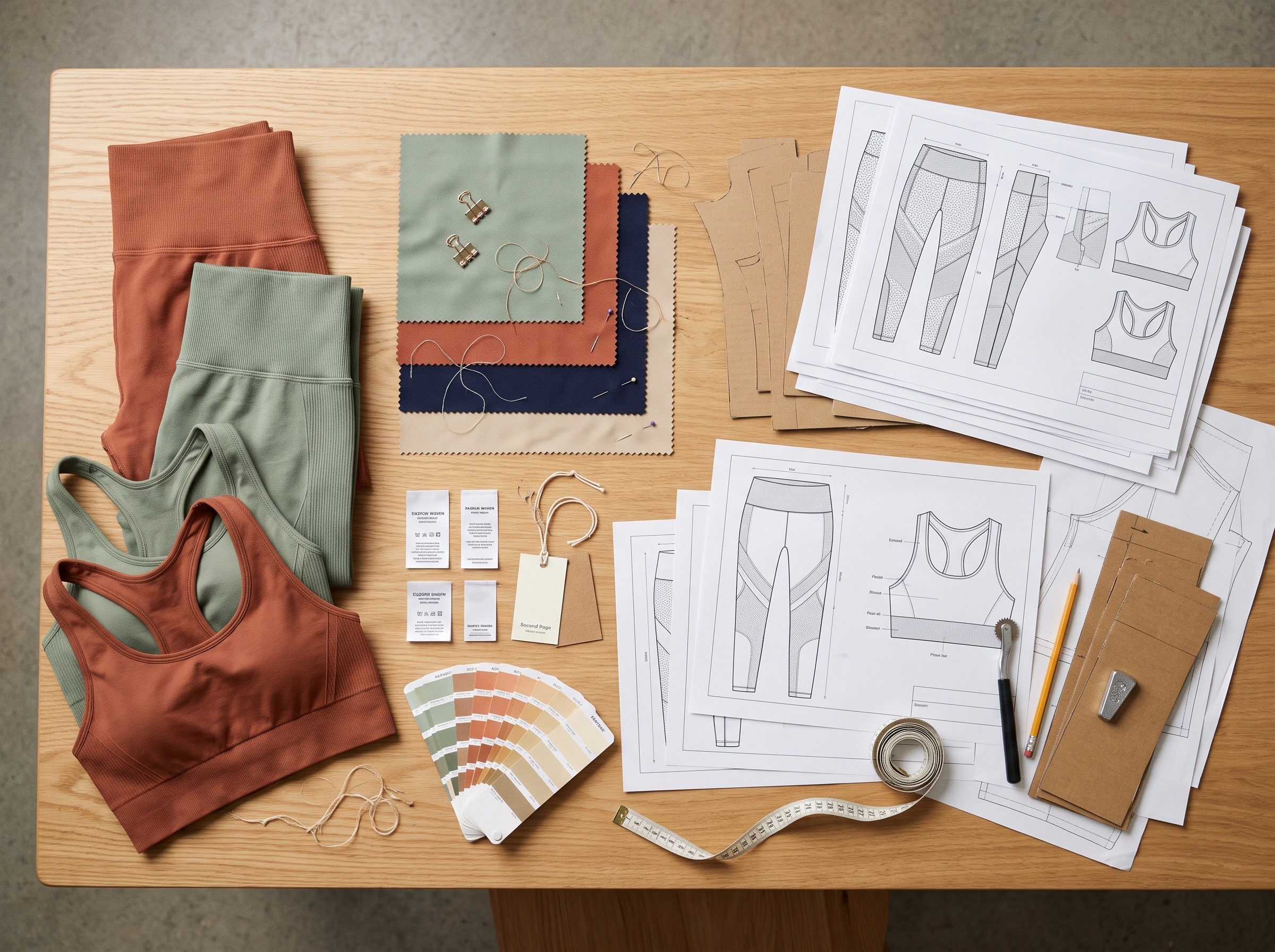 , in the order a factory reads them
A pack is read in a fixed order. The bill of materials (BOM) is the component list of a style; the points of measure are its measurement map. Keep this sequence:
| Section | What to put in it | Prevents |
| Style overview | Style number, category, target market, size range | Rework |
| Bill of materials | Every component and its reference: fabric, elastic, thread, labels, hangtag | Substitutions |
| Fabric specification | Composition, weight in GSM and oz/yd², stretch, recovery | Bagging |
| Points of measure | 10–12 finished measurements with tolerances | Fit drift |
| Construction callouts | Seam type per seam, gusset shape, waistband depth, stitch density | Seam failure |
| Colourways | One Pantone TCX per colourway, plus lab dip approval | Shade mismatch |
| Artwork and labels | Vector logo, print position, label position and wording | Wrong seam |
| Packaging | Polybag, hangtag, size sticker, carton mark | Chargebacks |
| Reference sample | A bought sample in your best-selling size | Vague fit |
Points of measure: the numbers that stop fit drift
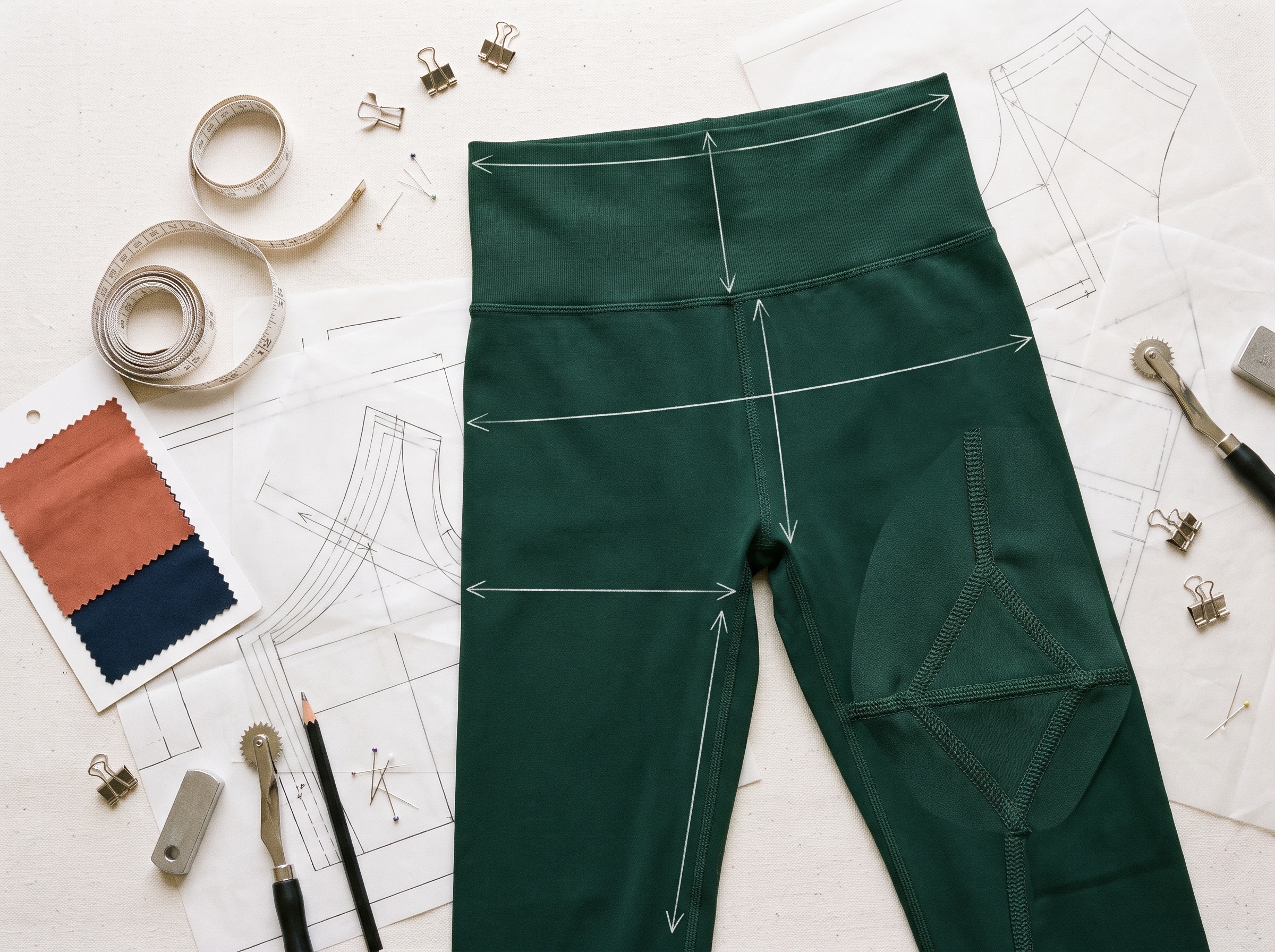
A point of measure is a defined location on the garment where a finished measurement is taken. Each row needs where to measure, the target for the base size, and a tolerance. Bands below are typical for knit leggings; confirm per style and fabric.
| Point of measure | Where to measure | Typical tolerance |
| Waist width, relaxed | Across the front waistband, then doubled | ±1 cm (±3/8 in) |
| Hip width | 7.5 cm (3 in) below the waistband seam, doubled | ±1 cm (±3/8 in) |
| Thigh width | 2.5 cm (1 in) below the crotch seam, doubled | ±0.8 cm (±5/16 in) |
| Inseam | Crotch seam to hem, along the inside leg | ±0.6 cm (±1/4 in) |
| Front rise | Top of waistband to crotch seam, front | ±0.6 cm (±1/4 in) |
Write lengths in both units: a 25 in (63.5 cm) inseam is not 63.1 cm, and a pattern room working in centimetres reads units literally. State whether measurements are flat or stretched. Starting from an in-stock base on our custom yoga leggings manufacturer page shortens this: rows are pre-drafted and only need grading.
Fabric specification: replace "buttery soft" with numbers
"Soft" is not a specification. Five fields carry the information:
· Composition by percentage, for example 76% nylon / 24% elastane. It drives cost and recovery.
· Weight in GSM and oz/yd². Training leggings usually sit at 200–280 GSM (5.9–8.3 oz/yd²); lighter reads sheer under stretch.*
· Stretch and recovery. Ask for four-way stretch and recovery after repeated extension; recovery, not stretch, stops knees bagging.
· Opacity under stretch. Name the test: form, deep squat, daylight photo from behind.
· Shrinkage after washing, with the wash cycle named.
Construction callouts that matter on leggings
Most legging failures are seam failures, so name every seam line. Flatlock (four-thread) is usual for inseam, side seam and gusset because it lies flat on skin; overlock belongs inside a waistband where bulk is hidden. Add a gusset callout with shape and dimensions, state whether the crotch seam is bartacked, and specify waistband depth in both units, folded band versus tunnel with elastic, and stitch density.
Grading, size range and label content
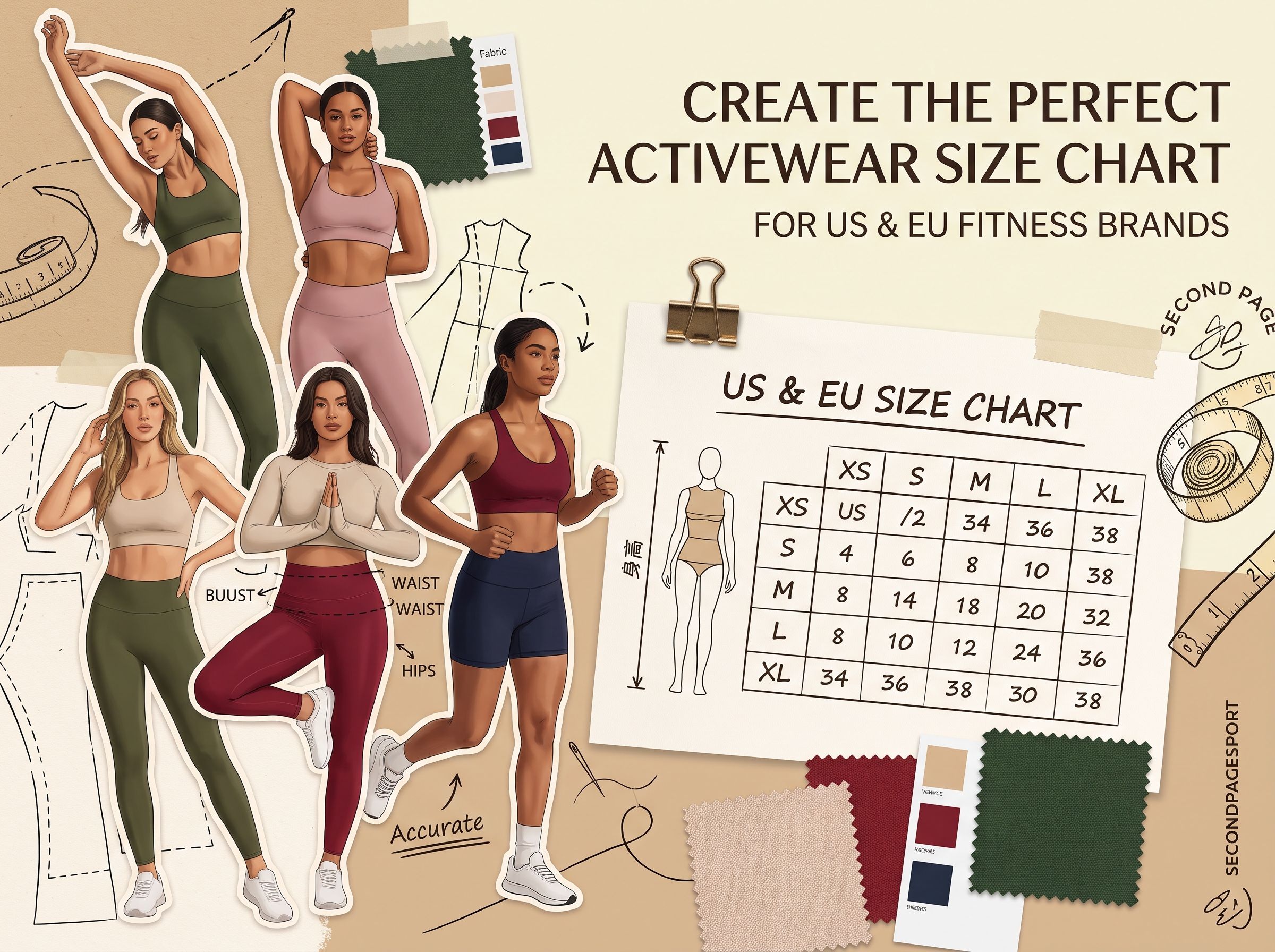
Grading is where one base size becomes a full size run using fixed increments. Put the range, base size and increment in the pack. ISO 8559-1:2017, *Size designation of clothes — Part 1*, defines how body measurements are named and taken.
Label content belongs in the pack. In the US, the FTC Care Labeling Rule requires instructions covering washing, bleaching, drying, ironing and warnings. In the EU, Regulation (EU) No 1007/2011 requires fibre composition in descending order by weight. If a buyer specifies OEKO-TEX STANDARD 100, note the product class — Class 2 covers skin contact — and confirm which certificate covers your style.
Reviewing the counter sample in twenty minutes
A counter sample is the factory's first physical build of your pack. Check it in four steps: flat measurements against every POM row, waistband recovery after five stretches, a squat and lunge on a real body, then gusset seams under light. Photograph each failure on the garment; a marked-up photo removes a revision cycle.
FAQ
1. Do I need a tech pack to order 10 sets?
No for stock styles. Stock designs already have patterns and specs; you confirm colour, label and packaging only. A pack is required for private-label changes and modified styles, where MOQ starts from 10 sets per style, confirmed per model.
2. Can I write a tech pack without pattern-making experience?
Yes, if you measure a garment you own instead of inventing numbers. Lay a well-fitting legging flat, record the five points of measure above, take fabric weight from a spec sheet, and describe seams from photos. Factories build accurate counter samples from a measured sample plus clear callouts.
3. How long does a tech pack take to write?
A first pack takes most brands 4–8 hours: two for measurements, one for the BOM, two for construction notes, the rest for artwork. Reusing it as a template cuts the next style to under two hours, since only fabric and measurements change.
4. What is the difference between a tech pack and a spec sheet?
A spec sheet is one part of a tech pack — usually the measurement and fabric pages. A tech pack is the complete set.
5. Should I send a physical sample or photos?
Both. The sample settles fit and hand-feel; photos leave weight and drape to interpretation.
6. Does a tech pack need to be in English?
English is the working standard for US, EU and AU buyers. A bilingual measurement table covers the rest.
Next step
Send your pack, or the legging you want to match, and we will quote against a real fabric and construction. If the legging will ship as a set, our custom sports bra manufacturer page lists tops most brands pair with it. Bulk production runs 15–20 days after custom details are confirmed, following a five-step inspection. Minimums start at 10 sets per style; fabric weight, stretch and MOQ are confirmed by style and model. Email or WhatsApp +86-181 5606 3146 (Jerry Ding) with a style reference.